Mist of Verdure
SOLO EXHIBITION
JIANGSU CHINA2025
"Mist of Verdure" — Sensory and Brain Healing through Nature
In today’s world, many individuals living with mental health challenges, trauma survivors, and neurodivergent people experience a phenomenon known as “sensory blurring.” This refers to the difficulty of clearly perceiving images, touch, smells, and even losing a sense of spatial orientation and bodily boundaries. These conditions may stem from mental health disorders such as depression, anxiety, trauma, blindsight, or sensory perception challenges found within the autism spectrum. Additionally, they can result from accumulated stress, emotional numbness, and disconnection from the daily rhythm of life. "Mist of Verdure" is an experimental art project that explores how nature can help individuals reconnect with their emotions, bodies, and sense of time through sensory restoration and empathy.
In the heart of the forest, as we inhale the fresh air, our minds open to a new sensory experience. The tension in the prefrontal cortex begins to dissolve, the alarms in the amygdala quieten, and the hippocampus gently gathers fragments of memories, much like soft, fallen leaves, creating a space of refuge for our thoughts. "Mist of Verdure" invites the viewer on a journey of breathing between the trees and the brain, where nature and mind come together in harmony.
Through her art, Elisa combines cognitive neuroscience research with personal experience, offering a first-person perspective on forest therapy. Each piece in the collection not only celebrates the beauty of nature but also explores how being in nature can restore sensory perception and help bring inner balance. For Elisa, forests have provided a sanctuary—offering solace from emotional turbulence and trauma. Under the canopy of trees, she has experienced firsthand how nature impacts the brain, fostering improvements in brain structure and neurochemical balance, particularly concerning sensory and neurological imbalances.
Nature offers more than just psychological support; it has the potential to improve brain health and sensory function. "Mist of Verdure" is an invitation to slow down, to listen to the shared pulse between the trees and ourselves, and to find peace within the embrace of nature.
—— Curatorial Team

EXIHIBITION DOCUMENTATION


The work begins with a simple experience: when the body moves through a forest, it is not only entering an external natural environment. The brain itself is continuously perceiving, adapting, and reorganizing. The growth, branching, and overlapping structures of trees led me to connect processes of growth in nature with the invisible plasticity of the nervous system.


For about half year, I participated in weekly forest therapy, making regular immersion in the forest part of an ongoing physical and psychological practice. As the experience continued, I began to notice gradual but persistent positive changes in my physical and mental well being.
These changes led me to a question: what was actually happening in my brain as I felt myself changing? This curiosity led me to research the relationship between natural environments, physical activity, neuroplasticity, and adult hippocampal neurogenesis (AHN), as I began to consider how experiences in the external environment might relate to ongoing changes within the brain.


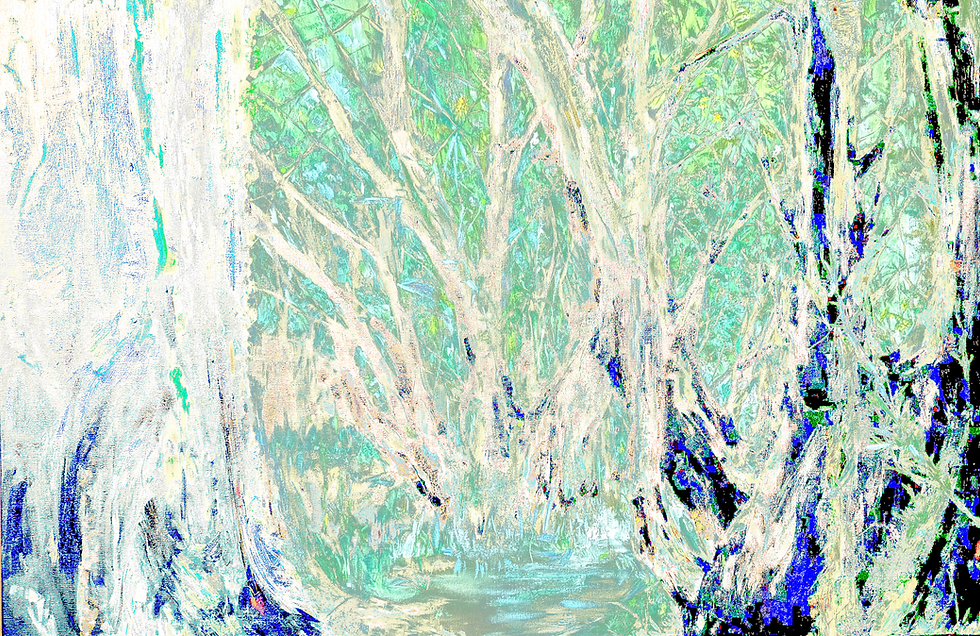
At the same time, I began using artistic practice to document and reinterpret this process. I started by observing and sketching in forests, recording the structures of trees, branches, light, and vegetation, before gradually moving away from direct representations of the landscape. My practice became increasingly experimental as I explored how shifts in material, color, and light could suggest internal processes that remain invisible to the eye, eventually developing into this series of paintings combining oil paint and fluorescent pigments.

In these works, tree branches and neurons are not treated as scientifically equivalent, but as a visual analogy. The extension, branching, and interconnection of trees recall neuronal dendrites and continuously changing neural networks, allowing the forest to become a space between an external ecosystem and an internal neural landscape. “Growth” therefore refers simultaneously to plant life and to the brain’s capacity for ongoing change.

Each painting begins with a landscape constructed in oil paint, followed by two layers of fluorescent pigment. Under ordinary light, the viewer primarily encounters the external forms of trees and forest, while under ultraviolet light, the fluorescent layers become activated, causing previously concealed lines, branches, and colors to glow and reorganize the landscape. This hidden visual layer imagines neural changes that cannot be directly perceived by the human eye, temporarily transforming the forest into an internal “neural landscape.”
Rather than directly illustrating a neuroscientific process, the work draws on research into adult hippocampal neurogenesis (AHN) and neuroplasticity as a way of reconsidering our experience of nature. As the body moves through a natural environment, both the external landscape and the internal nervous system exist in states of change. Mist of Verdurebrings these two scales of living activity into the same visual field, creating a connection between the growth of trees, bodily movement, and the invisible transformations occurring within the brain.


These three works emerged from my personal experience with forest therapy. Through repeatedly returning to the forest, I gradually found a sense of calm and belonging that I rarely experienced in everyday life, as my body began to release its habitual tension and alertness. The figures are therefore placed among trees, roots, and branches that appear much larger than the human body, suggesting not an observer looking at nature from a distance, but someone being held by the forest and temporarily becoming part of it.
This sense of belonging also changed the way I looked at the forest. I became increasingly attentive to the ways roots extend into the ground and branches divide, overlap, and connect, structures that gradually reminded me of neuronal dendrites and neural networks. Painting the forest therefore led me toward another question: when I experience calmness and change within nature, might there also be invisible changes taking place within my brain?


After repeatedly returning to the forest, natural landscapes began to enter my dreams and reappear in forms that differed from reality. The painting retains the basic structure of a forest, but the plants are reconfigured into forms that do not fully belong to the real world, while numerous small fluorescent particles are scattered throughout the space, making the forest appear to be growing, floating, and constantly shifting. Rather than documenting a specific place, this work reconstructs my experience of nature through memory and dreams, marking my first attempt to transform the forest from an external landscape into an internal psychological space.


